
Mireille Darc — the embodiment of grace, feminine dignity, and devotion.
“I prefer smiling to complaining — it’s easier for me. To move forward, one must have self-respect. I have it, so I must go on.”
“ Je préfère sourire que de me plaindre, c’est plus facile pour moi. Pour avancer, il faut avoir de l’estime pour soi. J’en ai, je devrais avancer.” Mireille Darc
In everyone’s life, there comes a moment to take stock. It seems that my moment has come. Although, at least, I had a reason. Ten years after my mother’s death, I accidentally discovered what was perhaps my greatest secret—the one that had poisoned my childhood. It turned out that my father, Marcel, was not my biological father…
The revelation stunned me, and I vividly recalled how lonely I had felt in my own home. Mostly because of the way my parents treated me—my mother never showed me tender feelings; her affection was restrained, almost secretive—now I understand why. But my father…
It seemed as if he hated me. Passing by, he would rudely shove me in the back, whisper curses, and often call me a “foundling.”
At that time, I did not understand the meaning of the word; I thought it meant something like “naughty girl.” I kept asking myself: what had I done to upset my father so much? Perhaps it was all because of my parents’ relationship—I had noticed that they slept in separate rooms; my father sat sullenly at the table and spent entire days hunched over his garden beds.
I wore the hand-me-downs of my older brothers; there were no concessions for me, even though I was the youngest and a girl. When I got sick, I endured sore throats and flu on my feet. Years later, this would have a fatal effect on my heart—I developed mitral valve stenosis.
I had no toys. No dolls either. No gifts for birthdays or Christmas. No holidays. And at school, I suffered from the cruelty of teachers.
My only refuge was the attic—only there, hiding from everyone, did I feel safe. Sounds from the street reached me, the clatter of dishes from the kitchen, the voices of my family—I was, in a way, both with them and apart, behind an invisible boundary, in my hiding place.
One day, my father roughly grabbed me by the arm and dragged me up to the attic. I was terrified; before, he had only touched me to scold or mock me, but this time… His usually expressionless face was distorted by a grimace of hatred. I obediently followed him.
Once in my secret hiding place, my father ordered: “Stand here and watch—I’m going to hang myself right now. Because of you. You’ve brought me nothing but misery!”
I burst into tears: “Daddy, what have I done wrong? Why are you angry with me?” “What did you do? You’ve driven me to this state, I want to die. I will hang myself right before your eyes!”
“No, Papa, don’t! Don’t die! I don’t want you to die! Please…”
Oh God, I was only eight or nine years old…
It seems that this experience only made Mireille stronger, more resilient—and yet did not harden her nature. Upon coming of age, she left her childhood home. In Paris, she enrolled in the Conservatory of Dramatic Arts. To pay for her studies, she worked as a waitress, walked dogs, and rented a tiny apartment in a poor district of the city.
A chance encounter with the popular singer Gilbert Bécaud changed her life. Following his advice, she went to an artistic agency and landed a small role in Bernard Shaw’s play at the Gramont Theatre.
More offers soon followed, and she found herself acting alongside Michel Piccoli, Louis de Funès (in three films), Jean Gabin, and Lino Ventura, achieving particular success in comedies. Mireille also starred in Galia, a film by Georges Lautner.
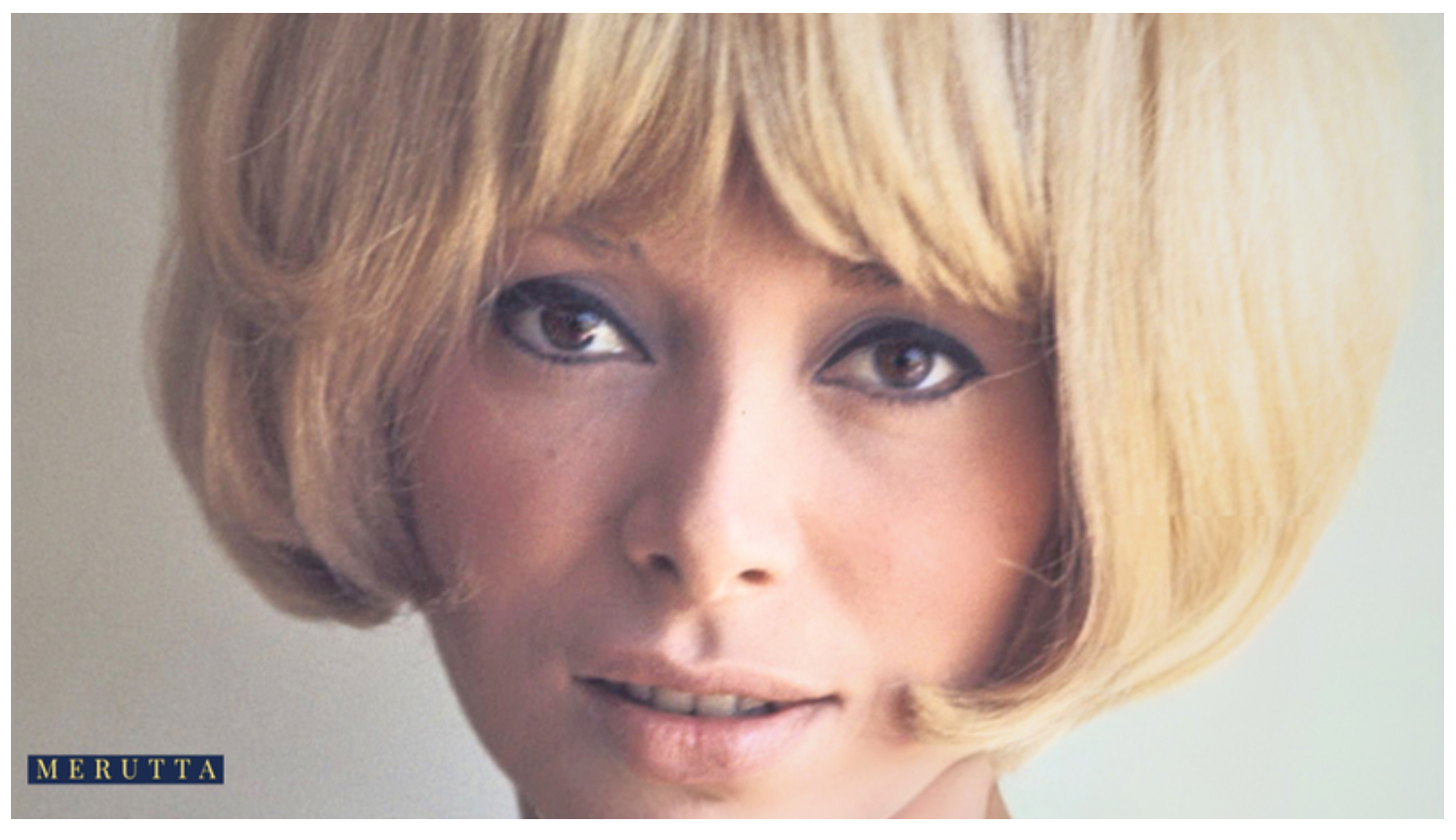
It was he who insisted that she dye her hair blonde. “The moment I saw myself as a blonde, I realized that this was truly me,” the actress later recalled.
-
“Nature has always mattered to me. It’s important for me to touch a tree. I can speak far more to trees than to my friends.”
“La nature a toujours été importante. C’est important pour moi de toucher un arbre. Je peux parler bien plus aux arbres qu’à mes amis,” Mireille Darc
Everyone knows about her fateful meeting with Alain Delon on a plane and that their romance began much later—during the filming of Jeff in 1968 in Rome, where they were carefree and happy. They truly loved each other.
“I was so happy! I kept telling myself: this is not a dream, you are in the most beautiful city in the world, next to the most beautiful man, and for the first time, you are not afraid to love. For the first time, you dream that this feeling has a future.
It was incredible. New. Strange. Before, I never wanted to be attached to anyone for long, seeing love only as a fleeting adventure. But with Alain, I suddenly wanted everything—family, a shared home, children,” Mireille Darc later recalled.
Upon returning to Paris, Mireille moved in with Alain, and during this time she proved her loyalty to him, standing by his side when many turned away. This was during the long-running investigation into the murder of Stevan Marković, in which Delon was initially considered a suspect. The case dragged on for nearly seven years. Despite all advice to leave him, Mireille refused to abandon Delon.
“It was at that moment that we both realized our feelings were not just an affair but something real. We no longer had to prove anything to each other,” she later said.
Now, many years after their separation—they parted ways in 1983—one can say with certainty: if there was ever a true feeling in the lives of these two actors, it was love. It was mutual, sincere, profoundly human—not a fleeting passion, but an inner constant that endured through time, doubt, and change.
Their paths diverged, yet their bond never broke. There was no melodrama or pose in it—only the rare nobility of two people who managed to preserve respect, loyalty, and warmth despite all they endured. They called each other, supported each other, remained closer than many who call themselves family.
And if we see them not merely as actors but as human beings, this is perhaps the true summit of emotional and artistic maturity. Their story is neither a tragedy nor a legend, but proof that love can be an extension of dignity, and friendship—a quiet form of eternity.
And as the camera slowly pulls away, leaving them in the gentle light of their lived years, we see not stars, but people—lives rich, full, carried with rare grace and nobility. They bore their destiny with dignity and remain in memory not as cinematic icons, but as two beautiful human beings who turned life itself into art.
“Every morning I smile at myself in the mirror. It gives me incredible energy.”
“Je me souris dans la glace tous les matins. Cela donne une pêche d’enfer,” Mireille Darc